Guide · Stool chart
Bristol stool chart: the 7 types in plain words
The Bristol stool chart sorts stool into seven types, from hard pieces to liquid. See all seven in plain words with simple drawings, get a free printable PDF, and learn how to use it in a diary.
In short: the Bristol Stool Scale, often called the Bristol stool chart, describes stool form in seven types, from separate hard pieces (Type 1) to fully liquid (Type 7). Types 3 and 4 are generally considered the typical range. The chart describes what you see; it does not diagnose anything.
The seven types
| Drawing | Type | Name | What it looks like |
|---|---|---|---|
 | Type 1 | Hard pieces | Small, separate balls |
 | Type 2 | Lumpy | Firm and clumped |
 | Type 3 | Cracked | Formed, with cracks |
 | Type 4 | Smooth | Soft and even |
 | Type 5 | Soft pieces | Separate, soft edges |
 | Type 6 | Loose | Shapeless, broken up |
 | Type 7 | Liquid | No solid pieces |
These are our own words and drawings, the same ones used in the Gut Elements app. They are not a copy of the official chart.
Printable Bristol stool chart (PDF)
Download the Bristol stool chart (PDF, 1 page, A4)
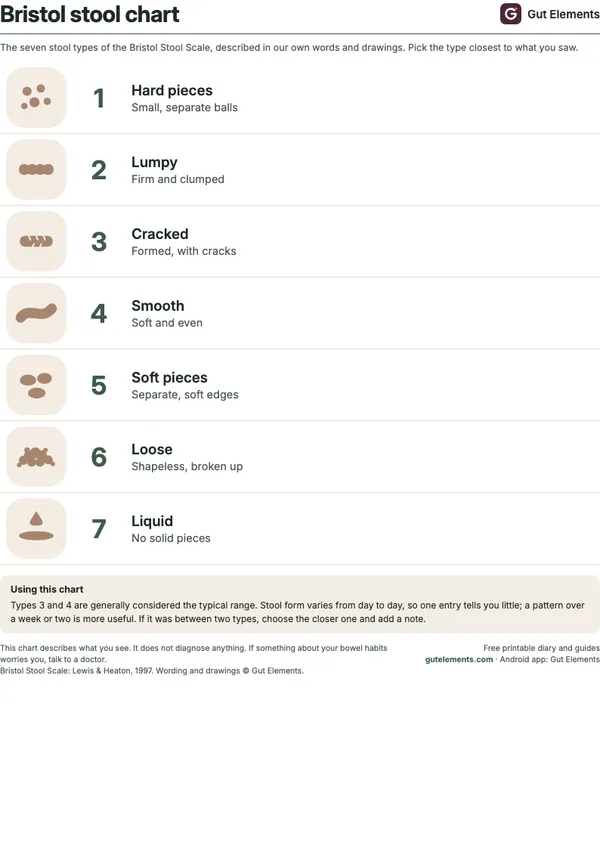
Free, no sign-up. It has the same drawings and wording as the table above, on one page you can print and keep next to your diary.
Where the chart comes from
The scale was published in 1997 by Lewis and Heaton, from the Bristol Royal Infirmary in the UK, as a consistent way to describe stool form. Source: PubMed, checked October 18, 2026. It is now widely used in clinics and research. The official chart is published by the Rome Foundation; this page explains the types in plain words rather than reproducing it.
What “typical range” means
Types 3 and 4 are generally considered the typical range. Stool form can vary from day to day, and a single entry tells you little on its own. A pattern over time is usually more useful, and that is what a diary shows.
If you notice a lasting change in your bowel habits, or anything that worries you, speak to a qualified healthcare professional. This page is for understanding the chart, not for working out what a type means for your health.
Using the chart in a bowel diary
- Each time, pick the type that matches most closely. If it was between two, choose the closer one and add a note.
- Write down the date and the time, and correct the time if you record it later.
- Treat days with no entries as gaps in the record, not proof that nothing happened.
You can use our free printable bowel diary, which includes this type key, or read how to keep a bowel movement diary for the basics.
In the Gut Elements app
Gut Elements shows these same seven drawings when you log. Tap the type that matches, and the date and time fill in automatically. Your history and simple summaries, including how often each type appears, stay on your phone with no account.
Piyush Sachdeva is the founder of Gut Elements and the accountable editor of this guide. Diagnosed with celiac disease at 13, he has spent most of his life learning how much his days depend on his gut, and built Gut Elements as the simple, private bowel tracker he wanted. He is not a doctor or dietitian; he shares his own experience, not medical advice.